How Questions Marks Effect Speaker Tone and Message in Let America Be America Again
Andrew has a corking interest in all aspects of verse and writes extensively on the subject. His poems are published online and in impress.
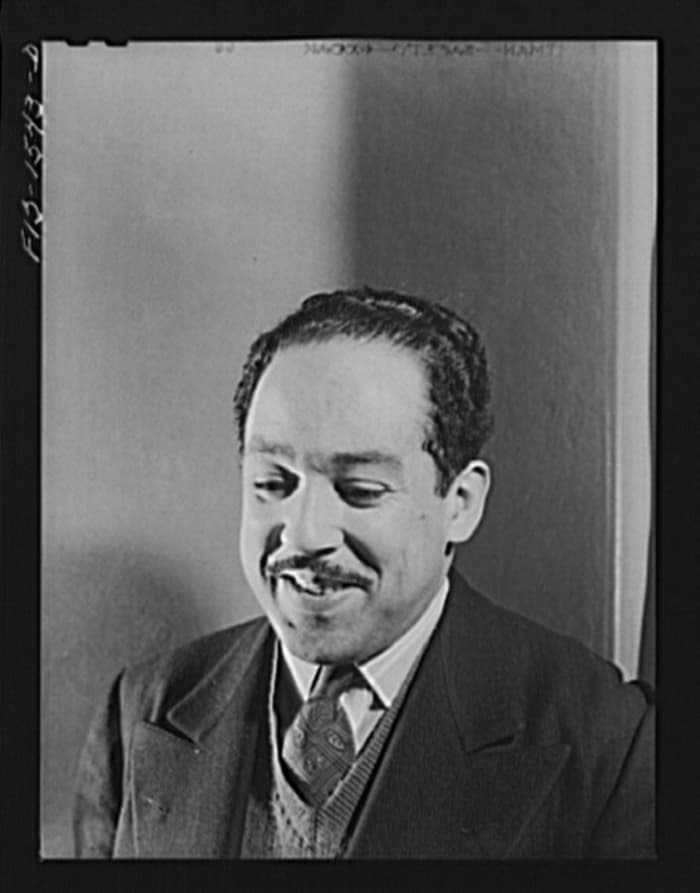
Langston Hughes
Langston Hughes And A Summary of "Allow America Be America Once more"
"Let America Be America Once more" focuses on the thought of the American dream and how, for many, attaining freedom, equality, and happiness, which the dream encapsulates, is virtually on incommunicable.
The speaker in the poem outlines the reasons why this ideal America has gone, or never was, merely could still exist.
For the poor, the oppressed and the downtrodden, the reality of day to twenty-four hour period existence makes the dream a cruel illusion. The poem explores the darker areas of life, the history of exploitation for example, and outlines the unique struggles of the poor who make upwardly America, both blackness and white.
Whilst pessimistic and difficult hitting, the verse form does have an optimistic ending and lights the way forrad with promise.
Langston Hughes was going through a difficult period in his life when he wrote this verse form. He knew he wanted to earn a living through writing, but couldn't sustain his efforts, despite poetry book publication, most notably The Weary Blues.
It was on a train journey through Depression-struck America in 1935 that inspired him to pen this classic plea for a resurgence of the true American spirit.
Publication followed in the Esquire magazine and Hughes went on to get a noted if controversial figure in the globe of blackness literature, following his earlier work in the and so-called Harlem Renaissance, an upbeat black artistic move peaking in the 1920s.
"Let America Be America Again" reflects the many influences in Hughes'due south poesy - from the expansive work of Whitman to street language, from jazz rhythm to the steady iambic lines of earlier black poets such as Paul Laurence Dunbar.
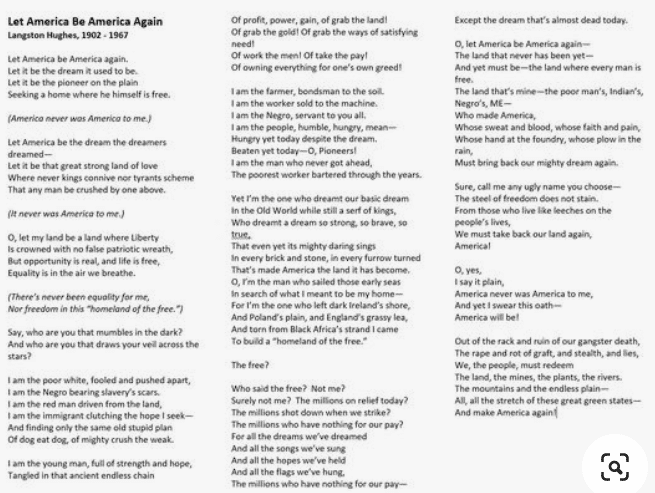
Let America Be America Again
Let America be America over again.
Let it be the dream information technology used to be.
Let it be the pioneer on the plain
Seeking a home where he himself is gratis.
Gyre to Proceed
Read More From Owlcation
(America never was America to me.)
Let America exist the dream the dreamers dreamed—
Let it be that great strong land of love
Where never kings connive nor tyrants scheme
That whatsoever human being exist crushed past 1 above.
(It never was America to me.)
O, permit my land be a land where Liberty
Is crowned with no false patriotic wreath,
But opportunity is real, and life is free,
Equality is in the air we breathe.
(There's never been equality for me,
Nor freedom in this "homeland of the complimentary.")
Say, who are you that mumbles in the nighttime?
And who are you that draws your veil across the stars?
I am the poor white, fooled and pushed apart,
I am the Negro begetting slavery'due south scars.
I am the red human being driven from the land,
I am the immigrant clutching the hope I seek—
And finding simply the aforementioned former stupid plan
Of dog eat canis familiaris, of mighty crush the weak.
I am the young man, full of strength and hope,
Tangled in that aboriginal countless chain
Of turn a profit, power, gain, of grab the land!
Of catch the gilded! Of catch the means of satisfying need!
Of work the men! Of take the pay!
Of owning everything for one's own greed!
I am the farmer, bondsman to the soil.
I am the worker sold to the machine.
I am the Negro, servant to y'all all.
I am the people, apprehensive, hungry, mean—
Hungry yet today despite the dream.
Beaten yet today—O, Pioneers!
I am the human being who never got ahead,
The poorest worker bartered through the years.
Notwithstanding I'one thousand the ane who dreamt our basic dream
In the Erstwhile World while still a serf of kings,
Who dreamt a dream then strong, and so dauntless, so truthful,
That even yet its mighty daring sings
In every brick and stone, in every furrow turned
That's made America the land it has get.
O, I'chiliad the man who sailed those early on seas
In search of what I meant to be my home—
For I'm the one who left dark Republic of ireland's shore,
And Poland's evidently, and England's grassy lea,
And torn from Black Africa's strand I came
To build a "homeland of the free."
The free?
Who said the free? Non me?
Surely not me? The millions on relief today?
The millions shot down when we strike?
The millions who have zilch for our pay?
For all the dreams we've dreamed
And all the songs we've sung
And all the hopes we've held
And all the flags we've hung,
The millions who have nothing for our pay—
Except the dream that's almost dead today.
O, allow America be America once more—
The state that never has been yet—
And notwithstanding must exist—the land where every human being is free.
The land that'southward mine—the poor man'due south, Indian's, Negro's,
ME—
Who made America,
Whose sweat and blood, whose faith and hurting,
Whose manus at the foundry, whose plow in the rain,
Must bring back our mighty dream once more.
Certain, call me whatsoever ugly name you choose—
The steel of freedom does not stain.
From those who live similar leeches on the people's lives,
We must take back our land once again,
America!
O, aye, I say it patently,
America never was America to me,
And yet I swear this oath—
America will be!
Out of the rack and ruin of our gangster death,
The rape and rot of graft, and stealth, and lies,
We, the people, must redeem
The land, the mines, the plants, the rivers.
The mountains and the endless plain—
All, all the stretch of these great green states—
And make America again!
Line-By-Line Analysis of "Let America Be America Again"
This whole poem is a crying out, a passionate plea for America to re-institute the Dream. It is a kind of personal hymn, a lyrical speech, to freedom and equality. To enable that plea to exist heard and felt, the speaker has to accept the reader through some dark times, through history, to explicate just why that Dream needs to live over again.
Lines one - 4
Alternate rhyme, repetition and alliteration are all at play in this the outset stanza, almost a vocal lyric. It'south a direct call for the old America to be brought back to life again, to be revived.
Note the mention of the pioneer, those first seekers of freedom who with tremendous will and endeavor established themselves a habitation, against all the odds.
Line 5
Almost as an bated, merely highly significant, the single line in parentheses reveals that, for the speaker, America as an ideal simply hasn't happened. For him, this romantic notion of the American Dream never has been. Why is that?
Lines vi - 9
The 2nd lyrical quatrain, with similar rhyme pattern, places stronger accent on the dream, the original vision people had for the USA, one of beloved and equality. There would be no feudal system in place, no dictatorships - everyone would be equal.
Note the contrast of the language used here. There is the dream and love of those who would be equal, against those who would connive, scheme and crush.
Line 10
Another line in parentheses, as if the speaker is quietly reasserting his inner voice - again making the indicate that this America hasn't existed for him, implying that he is far from the Dream. He is dubious to say the least.
Lines 11 - fourteen
The tertiary quatrain, with alternate rhyme for familiarity, highlights the outer ethics - the dressing up of Liberty only for show, which is phoney patriotism. The capital 50 reinforces the idea that this could exist the Statue of Liberty, the famous icon, based on a goddess, who holds the Declaration of Independence in ane manus and the torch in the other. Broken chains lie at her feet.
The plea continues, to brand the dream possible, to brand it manifest in opportunity and equality, for all. The proposition that equality could exist in the air people breathe, means that equality should be a natural given, role of the material that keeps the states all alive, sharing the common air.
Lines 15 - sixteen
The rhyming couplet in parentheses one time again repeats that, for the speaker personally, equality has been out of attain, perhaps simply has never existed. Same goes for freedom. (Homeland of the complimentary - could be based on the Star-Spangled Banner lyrics 'land of the gratuitous.')
Further Analysis
Lines 17 - 18
In italics for special reasons, these lines, two questions, represent a turning point in the poem; they are a unlike aspect of the speaker'due south identity. These two questions look dorsum, questioning the speaker's negativity (in parentheses) and too expect forrad.
The metaphor of the veil has biblical connections (in Corinthians) alluding to a darkening of reality, of not being able to see the truth.
Lines nineteen - 24
The commencement of the sextets, vi lines which limited yet another aspect of the speaker, who at present speaks every bit and for, one of the oppressed, in the first person, I am. Nonetheless, this voice too expresses the collective, articulating a mass sentiment.
And note that all types of person are included: white, black, native American, the immigrant. All are subject to the cruel competition and the hierarchical systems imposed upon them.
Lines 25 - 30
The second sextet focuses on the young homo, any young man no affair, caught upwards in the industrial anarchy of profit for turn a profit's sake, where greed is good and power is the ultimate goal. The ugly, unacceptable face up of capitalism encourages only selfishness at any expense.
Lines 31 - 38
Over again, use of the repeated phrase I am brings abode the bulletin loud and articulate in this octet: the arrangement is cruellest to those who are poorest. From the farmer to the servant, from the land to the fine houses of the wealthy, for many the Dream means simply hunger and poverty.
Workers become de-humanized, go mere numbers and are treated as if they are commodities or money.
Lines 39 - 50
The longest stanza in the poem, 12 lines, concentrates on the history of those immigrants who dreamt of fundamental freedoms in the first place. This is the cruel irony. Those fleeing poverty, war and oppression; those forced to leave their native lands, had this dream within, a dream of being truly free in a new land.
They travelled to America in the hope of realizing this dream. People from Erstwhile Europe, many from Africa, all set out for a new life, liberty and the pursuit of happiness (Thomas Jefferson).
More than Line Past Line Analysis
Line 51
A unmarried line, another potent question. The previous twelve lines (the previous 50 lines) all led to this acute point. A simple yet searching ask.
Lines 52 - 61
The next ten lines explore this notion of the gratis. Simply the speaker seems perplexed - where did this crazy question originate? It's as if the speaker doesn't know himself any longer, or the reasons why the question of the free should arise. Simply exactly who are the free?
There are millions with little or zip. When labor is withdrawn and legitimate protest arranged, the authorities annul with the bullet. Protest songs and banners and promise count for little - all that's left is a barely animate dream.
Lines 62 - 70
The speaker takes a deep breath and repeats the opening line, only with more emotional input.....O, let America be America again. This is a plea from the centre, this fourth dimension more personal - ME - withal taking in many different types of people.
In these nine lines the reader truly gets to know the speaker'due south intention and demand. Freedom for all. It's almost a telephone call to rising up and take back what belongs to the many and not the few.
Lines 71 - 75
No matter the abuse, the pursuit of freedom is pure and potent. Those who have exploited the poor and sucked out their lifeblood (annotation the simile - like leeches) demand to start thinking again about ownership and rights to holding.
Lines 76 - 79
A curt quatrain, a kind of summing upward of the speaker's whole have on the American Dream. A direct declaration - the Dream will manifest at some fourth dimension. It has to.
Lines 80 - 86
The final septet concludes that, out of the old rotten, criminal system, the people will renew and refresh and rebuild something wholesome and sustainable. At that place remains hope that the cherished platonic - America - can be made good again.
Literary Devices in Let America Be America Again
Let America Be America Over again is an 86 line poem split into 17 stanzas, three of which are unmarried lines, 2 of which are couplets. In add-on, at that place are iv quatrains, ii sextets, 1 octet, a twelve liner, ten liner, nine liner, quintet, and a vii liner.
The layout is quite unusual. On the page the poem looks more similar an extended song lyric, with quatrains followed past single lines and very short lines turning upward in mid-stanza.
Let's take a closer look at the literary devices:
Rhyme Scheme
Rhymes tend to bring familiarity and help reinforce meaning. In poetry, there are simple rhyme schemes and there are challenging ones. In this poem the rhyming pattern starts in a conventional style but gradually becomes more than circuitous.
For example, have a look at the first half dozen stanzas:
- abab - (b) - cdcd - (b) - bebe - (bb)
This is relatively easy to follow. There is an alternate design in the first 3 quatrains, with the strong full vowel rhyme e dominant:
be/complimentary/me/me/Liberty/free/me/complimentary.
The full finish rhymes leave the reader in no dubiousness about one of the main themes of this poem - freedom and me. A stiff pairing ensures a memorable bail.
Then, the first 16 lines are straightforward enough. Later on this the rhyme scheme gradually loses its regular blueprint and becomes stretched.
- Yet farther down the line then to speak, there are all the same loose echoes of the familiar alternating pattern established at the beginning of the poem.
Each of the larger stanzas contains some class of full rhyme, or full and slant rhyme:
soil/all with machine/mean and become/free with lea/costless.
Camber rhyme tends to challenge the reader because information technology is near to full rhyme but isn't total rhyme to the ear, as in soil/all. Information technology means things aren't clicking in full, they're a niggling bit out of harmony.
As the verse form progresses, rhyme becomes more intermittent and tends to condense in certain stanzas, as in stanza 13, pay/today and stanza xiv, pain/pelting/again. The poet'southward aim with such concentrated rhyme is to brand the words stick in the reader'due south mind and retention.
Literary Device (2)
Anaphora
Repetition plays an important role in this poem and occurs throughout. When words and phrases are repeated this has a similar issue to chanting, reinforcing significant and giving the feel of power and accumulation of energy.
From the first stanza - Let America/Let it be/Allow information technology be - to the last - The land, the plants, the mines, the rivers - there are repeats. Some critics have likened them to song lyrics, others to parts of a political speech, where ideas and images are built up again and once more.
Alliteration
At that place are numerous examples of alliterative lines - when words with leading consonants are close together - which bring texture and interest to lines and a claiming to the reader.
In the outset iv stanzas:
pioneer on the plain/habitation where he himself/dream the dreamers dreamed/state be a land where Liberty/slavery's scars.
Enjambment
Enjambment, when a line continues without punctuation on into the next, keeping the flow of sense, occurs in several stanzas. Await out for the 'open' end lines which encourage the reader to not pause but go on straight into the adjacent line.
For example:
Permit it exist the pioneer on the plain
Seeking a home where he himself is free.
and again:
We, the people, must redeem
The land, the mines, the plants, the rivers.
Metaphor
Tangled in that countless ancient chain
of profit, power, gain, of grab the land!
Personification
That even yet its mighty daring sing
in every brick and rock, in every furrow turned
Sources
www.poets.org
Norton Anthology,Norton, 2005
https://uwc.utexas.edu
100 Essential Modern Poems, Ivan Dee, Joseph Parisi, 2005
© 2022 Andrew Spacey
Source: https://owlcation.com/humanities/Analysis-of-Poem-Let-America-Be-America-Again-by-Langston-Hughes
0 Response to "How Questions Marks Effect Speaker Tone and Message in Let America Be America Again"
Post a Comment